BLFFD: Party Trivia
Piece of WebTrivia
4.93.00 Reviews
- Version
- 1.5.9
- Installs
- 50.00K
- Age Rating
- Everyone
Screenshots
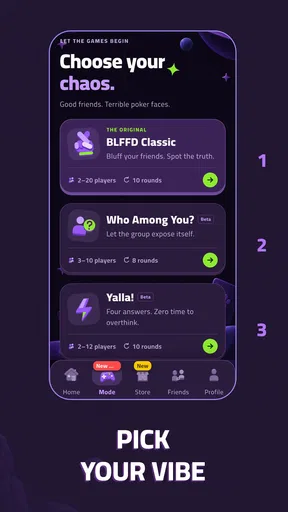
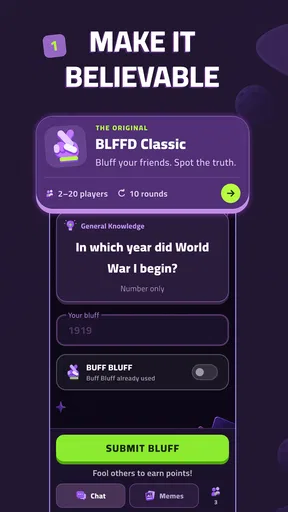
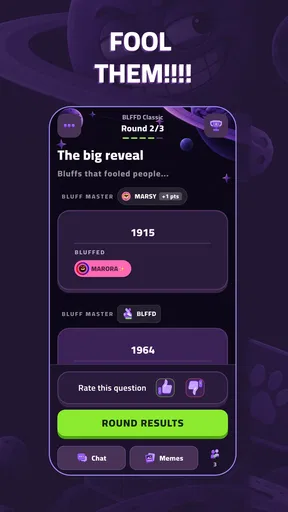
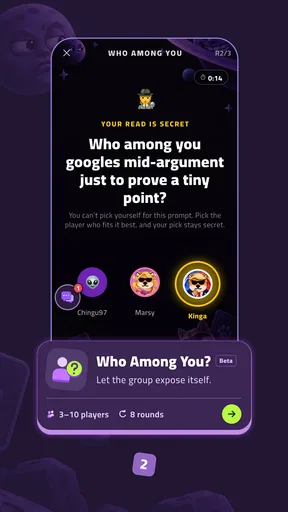
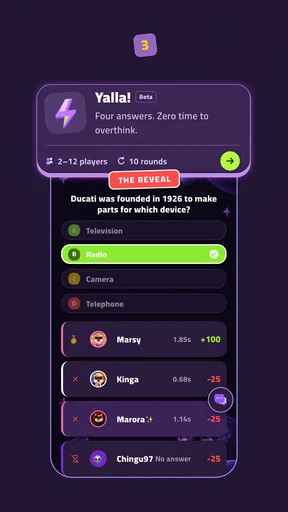
Our Review of BLFFD: Party Trivia
 Analysis by Appyee
I approached BLFFD: Party Trivia as the sort of game you open when a group is together and nobody wants to spend ten minutes learning complicated rules. Its core promise is simple: bluff your friends through trivia. That makes it more interesting than a standard question-and-answer quiz, because success depends not only on what you know, but also on how convincingly you can make an answer sound believable.
After spending time with it, I see the game as a social choice rather than a solo knowledge test. It works best when the people around you enjoy teasing one another, defending questionable answers, and admitting that confidence can be more useful than certainty. If you want a quiet trivia session against a computer, this is probably not the direction I would choose. If you want a lightweight party activity, it has a much clearer purpose.
How to decide whether this party trivia game suits your group
The first question is not whether you are good at trivia. It is whether your group enjoys bluffing. A conventional quiz rewards recall: you read a question, choose an answer, and move on. BLFFD: Party Trivia adds a social layer, so the fun comes from watching people commit to an answer and judging whether they actually know it or are improvising.
That distinction matters in everyday use. I would recommend it for a family gathering, a casual evening with friends, or a small break during a get-together where conversation has started to slow down. It can give everyone something to react to without requiring a long setup. The game is also easier to suggest than a board game that needs a table, pieces, and a full explanation before anyone can begin.
I would judge it on four practical points: whether your group likes verbal interaction, whether everyone is comfortable being wrong in public, whether the available session length matches a quick party game, and whether the trivia style feels welcoming to the whole room. The last point is especially important. A bluffing game can be entertaining for knowledgeable players, but it can also make less confident players feel exposed if the group treats every mistake too seriously.
The game is free to download, which lowers the barrier to trying it with friends. It includes in-app purchases priced from $0.99 to $9.99 per item, so I would still check the purchase flow before handing a phone to children or leaving the game running during a party. The content rating is Everyone, making it a broadly accessible choice, although the social tone will naturally depend on the people playing.
What the bluffing format changes
In a normal trivia app, I often find myself tapping quickly and forgetting the question almost immediately. Here, the answer becomes part of a small performance. You have to decide whether to give a confident response, keep it vague, or try to sound like someone who knows an obscure fact. That extra decision gives even familiar trivia a different rhythm.
One useful way to play is to treat confidence as a resource rather than pretending every answer is equally certain. When I know something, I can answer directly. When I am guessing, I can decide whether the subject is obscure enough that a confident bluff might work. This makes the game less about having the highest general knowledge and more about reading the room.
That also creates a hidden trade-off. A player who speaks convincingly may outperform someone who knows more but hesitates. Some groups will find that hilarious; others may prefer a system where factual knowledge is the main skill. Before starting, I would explain that the bluffing is the point, not a sign that someone is taking the game too seriously.
A realistic evening with BLFFD
Imagine a few friends waiting for food at home while conversation has reached a lull. One person opens the game, and everyone gathers around rather than committing to a longer activity. The first questions establish who tends to answer quickly, who overexplains, and who can sell an uncertain response. After a few turns, the group starts remembering each other’s habits, which becomes almost as entertaining as the trivia itself.
In that situation, the game works because it fills a gap. It does not need to become the main event. A short round can sit between dinner and another activity, or it can give a mixed group something shared to do while people arrive. I would not plan an entire evening around it before learning whether the group enjoys the format, but it is a sensible first option when you need a low-commitment party game.
My practical tip is to begin with people who already know one another. Bluffing depends on tone, timing, and personal habits, and those are easier to read among friends than among strangers. With a new group, I would keep the first session relaxed and avoid turning every answer into a challenge. The game becomes more enjoyable when players feel free to make ridiculous guesses without worrying about embarrassment.
Where this game is stronger than ordinary trivia apps
Its biggest strength is the way it turns passive answering into interaction. Many trivia games can be played while everyone looks down at a screen. BLFFD: Party Trivia is better suited to a room where people want to look at one another, react, and argue playfully about whether an answer sounds genuine.
That makes it a stronger choice than a standard quiz when the goal is conversation. A regular trivia app may be better for tracking personal knowledge or practicing facts, but this one has a more social identity. The question is not simply “Who got it right?” It is also “Who made the group believe them?”
I also like the low-pressure entry point. Because it is free, one person can suggest trying it without asking everyone to buy a game first. That is useful for mixed groups where some people are curious and others are reluctant. The Everyone rating supports that broad approach, while the simple party concept means the game is easier to explain than a title built around several connected systems.
The developer is Piece of Web, and the current version is 1.5.9. The game has reached over 50 thousand installs and carries a 4.9 average from around 235 ratings. Those figures suggest that the people who have rated it respond positively, but I would not treat them as a guarantee that every group will enjoy bluffing. Social games are unusually dependent on personality and setting.
Small strategies that make the sessions better
The first strategy is to avoid answering every question at maximum confidence. If everyone performs certainty all the time, the bluff becomes flat. I found the format more engaging when players varied their delivery. A genuine answer can be quick, while a questionable one can be presented with just enough detail to invite suspicion. The contrast gives other players something to analyze.
The second is to watch for overexplaining. A long explanation can make an answer sound researched, but it can also reveal that the player is trying too hard. In a group that enjoys deduction, asking someone why they chose an answer may be more entertaining than immediately checking whether it is correct. This turns the game into a conversation rather than a sequence of taps.
The third is to separate playful accusation from personal criticism. The game works when players challenge the answer, not the person. I would set that expectation early, especially with children or mixed-age groups. The Everyone rating makes it accessible, but accessibility does not remove the need for a friendly atmosphere.
A fourth useful approach is to give quieter players room to speak before the most confident person dominates the discussion. Bluffing naturally rewards strong personalities, so a group leader can improve the experience simply by inviting different opinions. That is not a feature hidden in a menu; it is a way of using the game more fairly.
Where another type of game may fit better
BLFFD: Party Trivia is not the best choice for every trivia need. If you want a focused solo challenge, a conventional quiz app is likely a better fit because it keeps attention on your own score and knowledge. If you want a deep competitive experience with carefully balanced progression, a larger multiplayer title may offer more structure. I would also choose a traditional board or card game when the group wants physical components and a longer, planned activity.
The bluffing format can become tiring if the same people are always expected to perform. Someone who prefers thinking quietly may enjoy trivia but dislike having their confidence judged by the room. In that case, a turn-based quiz with clear answers and less social pressure would be kinder. The right alternative depends less on which game is “better” and more on whether the group wants performance, learning, competition, or conversation.
There is also a difference between a party game and a trivia study tool. I would not use this title as my main way to build knowledge or review a subject. Its value comes from uncertainty and social reading, not from providing a structured lesson. If your goal is exam preparation, language practice, or systematic fact learning, another category will serve you better.
The same applies to large gatherings. In a crowded room, not everyone may be able to follow the discussion equally well, especially if several conversations are happening at once. A projected quiz or a host-led game can be more effective for a big event because the rules and answers are easier to present to everyone together. BLFFD: Party Trivia feels more natural when the players can hear one another and respond directly.
What to expect before installing
The game requires Android 7.0 or later, so it is compatible with a broad range of Android devices, though I would still make sure the phone used at the party is updated enough to run it comfortably. Since one device may become the center of attention, screen visibility and battery level matter more than they would for a private game. A small stand or a place where everyone can see the screen can make the session smoother.
Because the game is free, the financial decision is straightforward at first, but the presence of optional purchases means I would avoid assuming that every part of the experience is entirely cost-free. I would let the person organizing the session handle any purchase decisions rather than passing the phone around. That keeps the party focused and prevents an accidental tap from becoming an awkward interruption.
Another consideration is the group’s tolerance for repetition. Party trivia often depends on reactions and shared jokes, so the same questions or patterns may feel different with different people. If you are looking for an endlessly varied knowledge challenge, you may eventually prefer an app with a larger emphasis on subject selection or personal progression. I would install this one for its social moment, not as my only game of this kind.
The current version, 1.5.9, is the version I would use when evaluating it today. I would still keep the app updated through the normal store process, particularly before taking it to a planned gathering. That is a simple habit, but it avoids discovering an update or compatibility issue when everyone is already waiting to play.
The real cost of switching from another party game
Switching to BLFFD: Party Trivia is inexpensive in money because the game is free, but there is still a social cost. Your group may already understand the rhythm of a familiar card game or quiz app. Introducing a bluffing title asks everyone to learn a new style of participation, even if the basic idea is easy to explain.
The best way to reduce that friction is to run a short trial rather than announcing a full replacement for the group’s usual game. Play a few turns, let people discover whether they enjoy the bluffing, and then decide whether to continue. This also helps identify who prefers answering, who enjoys judging, and who would rather watch for a while before joining.
If your current alternative is a serious trivia competition, the switch may feel less satisfying because BLFFD: Party Trivia shifts attention away from pure accuracy. If your current alternative is a quiet solo quiz, the change will be much larger: this game asks for social energy and shared attention. On the other hand, if your usual party activity becomes repetitive, the bluffing angle can refresh a familiar evening without requiring a complicated new hobby.
I would also consider who owns the device used for the session. If one person must constantly hold the phone, that player may become the organizer instead of a participant. A good setup gives everyone a clear view and lets the host keep the pace moving. That small logistical point can make the difference between a lively round and a group waiting for one person to manage every step.
Who should install it and who should skip it
I think BLFFD: Party Trivia is a good match for friends who enjoy playful arguments, quick decisions, and the comedy of a confident wrong answer. It is especially suitable when you need an activity that can begin without much preparation. Families can also try it, provided younger players are comfortable with the idea that answers may be intentionally misleading and that the teasing stays friendly.
I would skip it if you mainly want a private test of factual knowledge, a detailed learning tool, or a game with a long strategic campaign. I would also hesitate to use it with a group that dislikes public guessing. No rating or install count can solve that mismatch. A highly rated social game can still be the wrong choice for people who would rather think silently and receive an immediate, objective result.
For players who are unsure, the free entry makes experimentation reasonable. Try it with a small group first, establish that bluffing is part of the rules rather than dishonest behavior, and notice whether the conversation improves. If people start debating answers and laughing at their own failed performances, the format is doing what it should. If everyone becomes quiet or frustrated, a more conventional trivia option will probably be better.
The 4.9 average and over 50 thousand installs give the game a reassuring starting point, while the Everyone rating makes it easy to consider for a broad audience. I would treat those as useful signals, not substitutes for matching the game to your group. The strongest evidence will be how quickly your friends begin reacting to one another instead of merely tapping through questions.
My recommendation after weighing the alternatives
I recommend BLFFD: Party Trivia when the decision is between a simple social game and another passive quiz. Its bluffing premise gives ordinary trivia a reason to create conversation, and the free download makes it easy to test without committing the whole group to a purchase. Piece of Web has positioned it clearly as a party trivia experience, and that focus is its main advantage.
My recommendation comes with a boundary: do not install it expecting a study app or a deep solo challenge. Choose it for a relaxed room, a few willing participants, and the kind of humor that comes from trying to sound certain when you are guessing. Keep the spending controls in mind, use a device everyone can see, and give quieter players space to participate.
For me, the deciding factor is the quality of the group interaction. When friends enjoy reading each other and defending absurd answers, the bluff is more entertaining than the score. When they want accuracy, progression, or individual improvement, another trivia category will be a better investment of their time. That makes this a focused recommendation rather than a universal one.
If that social style sounds like your kind of evening, I would try it before reaching for a more elaborate party title. It is easy to bring into an informal gathering, simple enough for newcomers to understand, and distinctive enough to change how trivia feels. Just remember that the game supplies the prompt; the quality of the experience comes from the people willing to bluff, question, laugh, and let someone else have the last word.
Verdict
Strengths of BLFFD: Party Trivia
- Quick party rounds are easy to learn and start with little preparation.
- Supports lively group interaction instead of solo play.
- Trivia variety helps keep repeated sessions from feeling identical.
- Simple format works well for casual gatherings and game nights.
- Short questions make it suitable for players with limited free time.
Limitations of BLFFD: Party Trivia
- Question difficulty may feel uneven across different categories.
- Some content may be less appealing to players outside its target audience.
- Requires a group of willing participants to be genuinely enjoyable.
- Replay value can drop after familiar questions appear repeatedly.
- A noisy party environment may make reading or answering difficult.
Similar Picks in This Category
View All
Millionaire 2026 Quiz & Trivia
Quiz & Trivia Games by Submarine Apps4.5

Brain Test 2: Tricky Stories
Unico Studio4.7

Trivia Crack: Brain Quiz Games
etermax4.4

QuizzLand. Quiz & Trivia game
Quiz & Trivia Games by Mno Go Apps4.8

Brain Test: Tricky Puzzles
Unico Studio4.7

Logo Quiz
bubble quiz games4.5
Frequently Asked Questions
What is BLFFD: Party Trivia, and how does the game work?
BLFFD: Party Trivia is a social trivia game designed for groups of friends, parties, and casual gatherings. Players answer questions, compete for points, and try to outperform everyone else across different rounds. The experience focuses on quick decisions, friendly competition, and entertainment rather than complex strategy, making it easy to start even if nobody has played before.
Can BLFFD: Party Trivia be played with friends, or is it suitable for solo play?
The game is primarily aimed at multiplayer sessions, so it is most enjoyable when several people are together and ready to participate. Before downloading, keep in mind that its main appeal comes from social interaction, conversation, and competition. Solo users may be able to explore parts of the app, but the complete party experience is intended for playing with friends or other participants.
Does BLFFD: Party Trivia require an internet connection?
Whether an internet connection is needed can depend on the specific mode, version, and platform features available in the app. Online access may be required for downloading question content, updating the game, using multiplayer functions, or accessing certain services. It is a good idea to install the latest version and check the app-store listing before planning to use it somewhere without reliable Wi-Fi or mobile data.
Is BLFFD: Party Trivia appropriate for children and family gatherings?
BLFFD: Party Trivia may work well for family events, but parents should review the available content and age rating before allowing younger children to play. Trivia topics, wording, advertisements, and player-created interactions can vary between versions. Adults should also consider whether the questions match the group’s age range and whether supervision is needed during multiplayer sessions.
Is BLFFD: Party Trivia free to download, and are there in-app purchases or advertisements?
The download price, advertising model, and optional purchases may vary between the Android and iOS versions or change after updates. Some features could be supported by ads, subscriptions, or paid content, so users should review the current store page before installing. Checking permissions, payment details, and purchase settings is especially important if children will use the device.
Play our best games!


